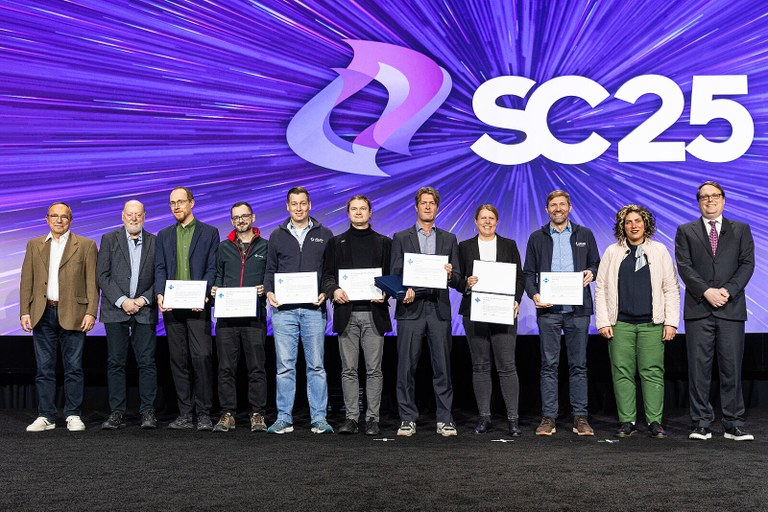
15.12.2025
Using the ICON Earth System Model, a research team led by the Max Planck Institute for Meteorology (MPI-M) and the German Climate Computing Center (DKRZ) successfully simulated the full Earth system — including atmosphere, ocean, land, and the complete carbon cycle — at a horizontal grid spacing of 1.25 km, achieving a throughput sufficient to simulate a decade of climate per month.
Developed over more than 20 years within the ICON partnership, ICON has been continuously adapted to exploit the hardware of the world’s most advanced supercomputers with exceptional efficiency. In this project, the team harnessed the full power of NVIDIA GH200 Superchips on two of Europe’s flagship systems: Alps in Switzerland and JUPITER in Germany. On JUPITER, an unprecedented time compression of 145.7 simulated days per day was achieved while utilizing 85% of the system’s computing resources.
The award-winning configuration was developed in close collaboration with experts from the ETH Zurich, Jülich Supercomputing Centre, the Swiss National Supercomputing Centre, the University of Hamburg, and NVIDIA. The simulations employed novel data-centric optimization techniques and leveraged both CPUs and GPUs within each node to balance Earth system components efficiently in a heterogeneous setup. This approach also enabled particularly energy-efficient simulations.
The success builds on many years of sustained development by the ICON community. Contributions from developers across the ICON partner institutions formed the foundation that made this achievement possible. The recognition through the prize highlights ICON’s readiness to exploit emerging computing technologies at scale and underscores the impact of long-term collaboration between climate scientists, software engineers, and HPC experts. It is a recognition not only of a single project, but of the collective efforts of ICON developers who continue to push the boundaries of global weather and climate modelling.
Among the finalists for the prize was a second paper also using ICON in the context of the Destination Earth digital twin for climate change adaptation. In that work, the coupled ICON model was employed — alongside ECMWF’s IFS in two configurations coupled to the ocean models NEMO and FESOM — on the EuroHPC platforms LUMI and MareNostrum 5.
References:
Klocke et at. (2025): Computing the Full Earth System at 1km Resolution. https://dl.acm.org/doi/10.1145/3712285.3771789
Hadade et al. (2025): Destination Earth: The Climate Change Adaptation Digital Twin. https://dl.acm.org/doi/10.1145/3712285.3771790
For further information: